
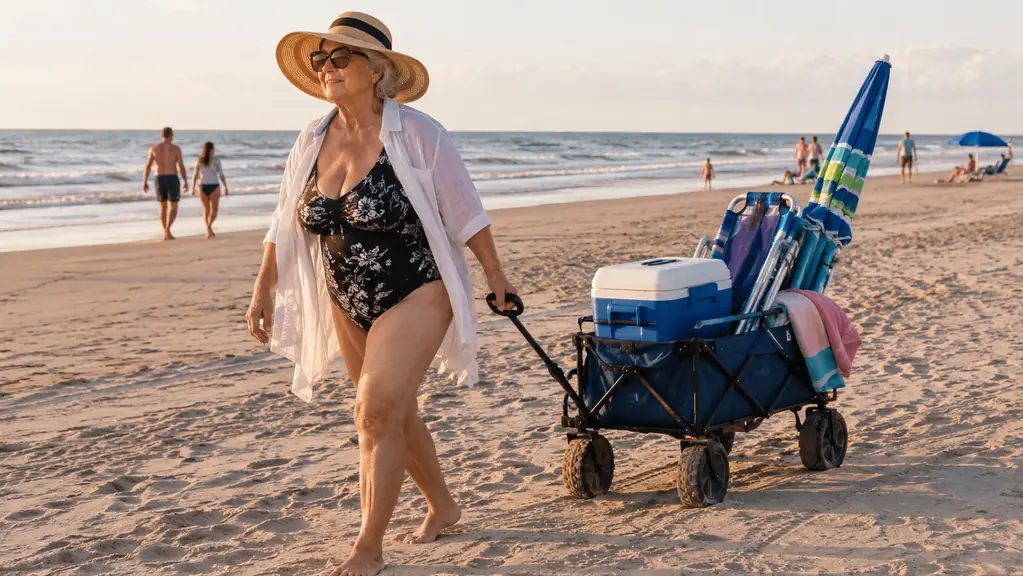
Every beach morning starts the same way at my house. I load the silver CR-V with chairs, a cooler, an umbrella, towels, and enough sand toys to build a small city, then I drive the fifteen minutes to the beach access I like best. The hard part starts after I park. The walk from the lot to the water is a good quarter mile, and most of it is soft, loose sand that grabs at your ankles and turns a simple carry into a workout. With three grandkids under nine, a stiff left knee, and both arms full, I used to arrive at the water already tired.
I tried every carrying method you can imagine. Bags on both shoulders, chairs hooked over my forearms, the cooler balanced on my hip while I held Ava's hand. It worked about as well as you would expect. Then my daughter Kristen suggested an Originsure beach wagon, and I will be honest, I rolled my eyes at first. Another piece of gear to store, another thing to haul. I even tried the plastic sled trick one year, and that lasted exactly one trip. But after a full summer of beach Saturdays with the Originsure wagon, I can tell you that owning one is only half the answer. The other half is knowing how to load it, how to pull it, and how to keep it rolling on sand that stops a regular cart cold. Here is the routine that works for me.
The wagon I load every beach morning
The Originsure 220L wagon rolls on four pneumatic tires, carries up to 460 pounds, and folds small enough to live in the back of my CR-V. It is the reason I still take the grandkids to the beach on Saturday mornings instead of finding excuses.
Amazon Check Today's Price on Amazon →Before I walk you through the steps, one thing you should know. I am not a gear person. I do not enjoy researching products, and I buy things once and use them until they fall apart. So the routine below is not about getting the most out of a fancy piece of equipment. It is about getting to the water with my grandkids and my energy intact. If that is your goal too, these five steps will get you there.
Step 1: Pack the Heavy Things Low and Centered
The Originsure wagon has a 7.69 cubic foot bed and a rated capacity of 460 pounds, which sounds like a lot until you start loading for three kids. The first time I used it, I piled everything in the middle and the wagon wobbled with every step. Now I know better. The trick is to think about where the weight sits, not just how much you pile in. I put the cooler in first, pushed against the front of the bed. Then the chairs go in on their sides, their weight resting on the floor of the wagon instead of leaning against the metal frame.
Sand toys and towels go on top because they are light and they fill the gaps. The umbrella slides in last, handle down, so it does not catch the wind. When I pack it this way, the wagon tracks straight behind me. When I am in a hurry and just toss things in, I can feel the difference in the first twenty feet. A balanced wagon is a wagon that rolls.
One note on weight. The wagon is rated for 460 pounds when it is sitting still, and the rolling capacity is 330 pounds. On soft sand, I keep the load well under that. A cooler, three chairs, an umbrella, towels, and a bucket of sand toys comes to maybe sixty pounds, and that is plenty for one person to pull. Just because the wagon can handle more does not mean your knee wants to.
Step 2: Check the Pneumatic Tires Before You Leave the House
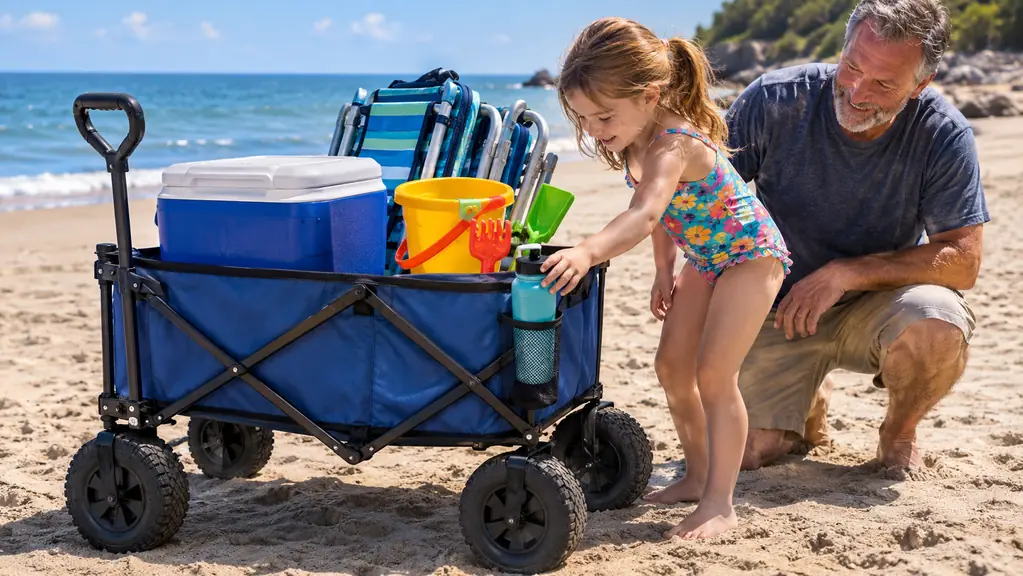
The single biggest difference between this wagon and the cheaper folding carts I looked at is the tires. Four pneumatic tires, the same kind you would find on a bicycle or a wheelbarrow, and they are what make soft sand manageable. But pneumatic tires only help if they are properly inflated. I check mine in the driveway before I load anything, because the last place you want to discover a soft tire is at the beach access.
The test takes ten seconds. I press my thumb into each tire and give the wagon a quick roll. If a tire feels squishy, or the wagon pulls to one side, I top it off before we leave. Under-inflated tires drag and dig into the sand. Over-inflated tires bounce and lose traction. The middle ground, where the tire gives just slightly under your thumb, is where they roll the smoothest.
I keep a small pump in the garage and check the tires about once a month during the summer, more often if we have been going every weekend. It is a boring chore, but it is the difference between a wagon that glides and a wagon that plows. The extra big all-terrain wheels are the whole reason this works on sand, and they deserve the two minutes.
Step 3: Pull at the Right Angle and Let the Wheels Do the Work
Here is the part nobody tells you about pulling a wagon through soft sand. The handle matters less than the angle. If I hold the handle high, the front of the wagon lifts and the rear wheels dig in. If I hold it low, the wagon rides level and the wheels roll over the sand instead of through it. I keep my pulling hand at hip height and let the wagon roll a step or two ahead of me. You can see the difference in the tracks. A level wagon leaves two clean lines. A nose-up wagon leaves a rut behind each rear wheel.
I also learned to pull in a steady rhythm instead of in bursts. Short, even pulls keep the wheels turning, and a rolling wheel stays on top of the sand. If I stop and start, the wagon sinks a little each time, and every restart is harder than the last. On the long stretch from the parking lot to the water, I pick a pace I can hold and just keep moving.
With my stiff left knee, I pull with my right hand and walk on the firmer sand beside the tire tracks. The wheels cut a pair of grooves, and the sand between them stays a little more packed, so I let the wagon break trail and I follow in its wake. It sounds like a small thing, but by the end of the summer it was the difference between enjoying the walk and dreading it.
Step 4: Use the Side Pocket and Mesh Cup Holders for the Small Stuff
The wagon comes with a side pocket and two mesh cup holders, and I ignored both of them for the first two trips. Then I spent ten minutes digging through the wagon looking for the sunscreen while Mason waited with a sand bucket on his head. Now the small stuff has a home. Sunscreen, my glasses, the car keys, and my phone go in the side pocket before we leave the driveway.
The two mesh cup holders are for the kids' water bottles. Lily and Mason are old enough to carry their own, but Ava is four, and her bottle ends up in the sand about every ninety seconds. Tucking it in the cup holder next to the side pocket means I can reach it without stopping the wagon, and the mesh lets sand fall through instead of collecting in the bottom.
The rule I settled on is simple. If it is small enough to get lost, it goes in the pocket or a cup holder. If it is too big for those, it goes in the wagon bed. Nothing dangles from the sides, and nothing balances on top of the load. A wagon full of loose odds and ends is a treasure hunt waiting to happen, and I have better things to do than hunt for a lost flip-flop.
Step 5: Fold It Down and Rinse It Before You Put It Away
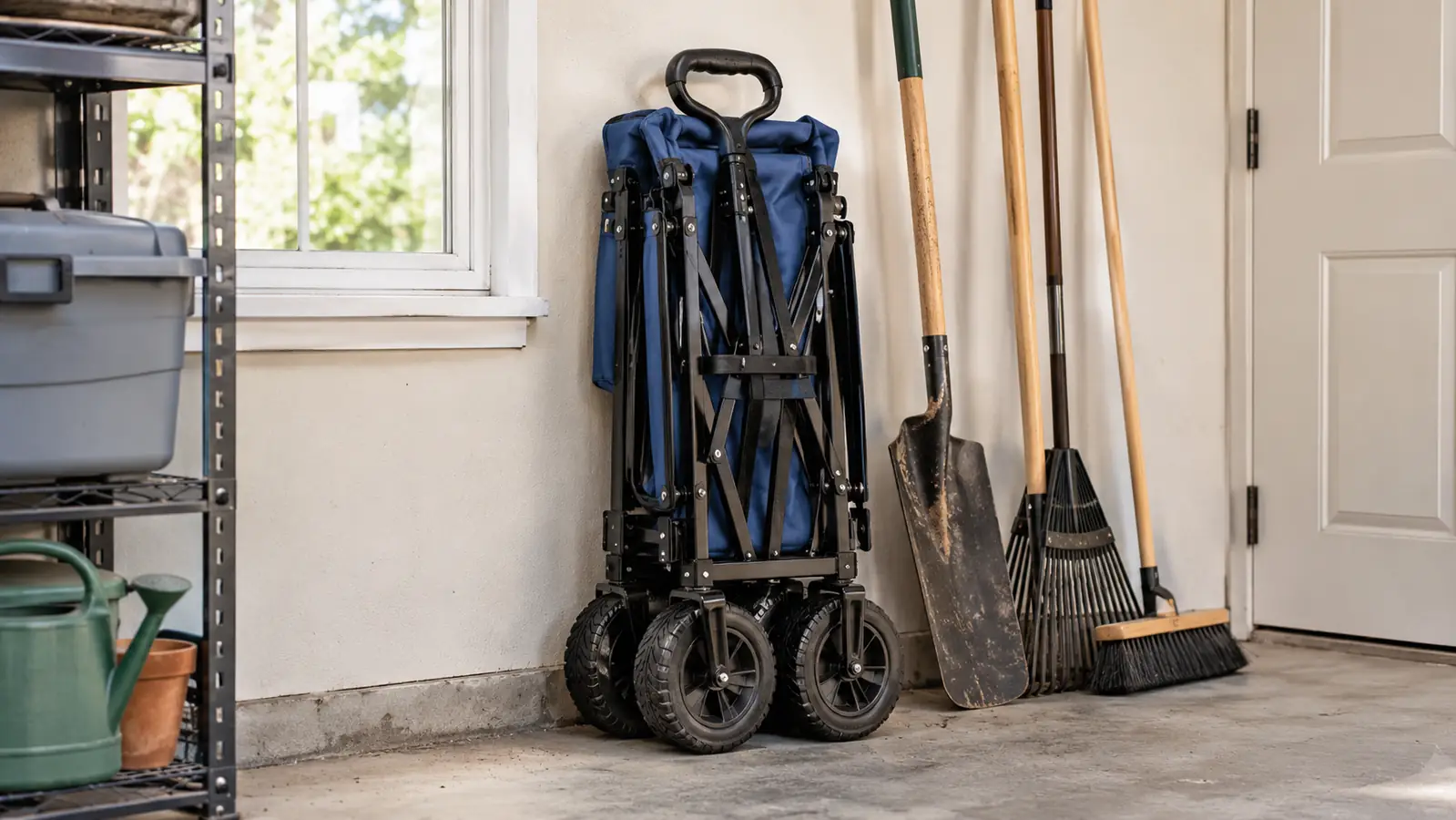
When the day is done, the wagon folds down to a compact size, about nine inches thick and a little over a foot wide. That is the part that sold me, because I have a one-car garage and no room for another piece of yard equipment. The folded size is what makes this a realistic purchase for me. I do not have a shed, and I am not going to store a wagon on the porch where it will rust in the salt air. It stands against the wall next to my gardening tools and takes up less space than a folding chair.
I fold it at the beach access, before I load it into the CR-V. That way most of the sand falls out on the ground instead of into my car. When I get home, I give it a quick rinse with the hose and let it dry in the sun before I fold it again. Sand left in the folds will grind into the joints over time, and a two-minute rinse is cheaper than a new wagon.
At 23.1 pounds, I can lift it into the back of the CR-V myself, which matters more than you might think. With my knee, I cannot manage the heavy folding chairs that some wagons come with. This one I can pick up, set on the tailgate, and slide into place without asking Dave to come help. That little bit of independence is worth a lot on a tired beach day.
What Else Helps
A few things I learned along the way that have nothing to do with the wagon itself. I keep a small tarp in the car and lay it on the sand for the kids to sit on, because chairs tip over in soft sand and the tarp gives them a flat spot. I bring a second, smaller bag for Lily to carry with her own towel and goggles, which makes her feel grown up and keeps her from asking me to hold things every five minutes. And I try to arrive before ten in the morning, when the sand is still cool and the parking lot is half empty. The wagon handles the gear either way, but a calmer beach is a better beach for everybody.
I also use the Originsure wagon as a base camp once we reach the water. I park it at the edge of the dry sand, near the water line, and use the bed as a clean spot for the towels and the side pocket as the sunscreen station. The kids know where their water bottles live, so they stop asking me where everything is. It does double duty that way, and it means I am not hauling gear back and forth all day.
One more thing about the walk back. I used to park as close to the beach access as I could, but the closest spots fill first and open last. Now I park a row farther out and let the wagon make up the difference. The walk is longer, but I am not carrying anything, so it does not matter. That is the whole point of a wagon, and it took me a full summer to really trust it.
The first trip with this wagon, I loaded the cooler, three chairs, the umbrella, and every sand toy we own, and my knee did not complain once. That is when I knew it was staying.
Make your next beach day the easy one
If you are tired of arriving at the water already worn out, the Originsure wagon is worth a look. It rolls on four pneumatic tires, carries up to 460 pounds, and folds small enough to live in the back of your car. One trip across the sand and you will wonder why you waited this long.
Amazon Check Today's Price on Amazon →