
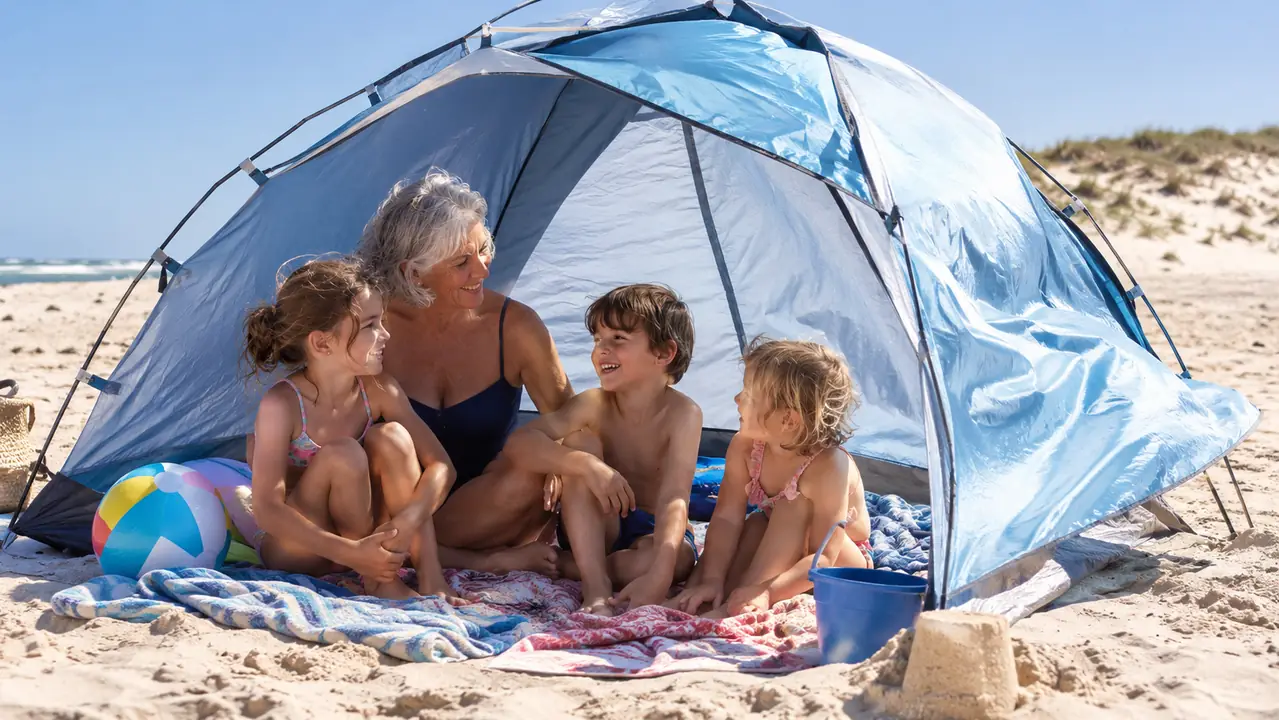
The wind was already up by the time we parked. I could see it in the flags by the access path, and I knew the next twenty minutes were going to decide whether we got a shady spot or a tent in our laps. If you have ever tried to set up a beach tent in wind with three grandkids circling your feet, you know the dance. The fabric snaps, the frame twists, and just when you think you have it, the whole thing tries to fly to the next beach blanket. I have done this enough times with the Gorich that I have a system now, and it turns a fight into a ten minute job.
Before I show you the steps, one honest note. No beach tent is windproof. The Gorich is a lightweight shade shelter, not a storm shelter, and I would never tell you otherwise. But it is a whole lot easier to manage than the cheap pop-ups I used to wrestle, and once you learn the order of operations, even a breezy Gulf morning is workable. Here is how I do it.
The Tent I Keep in the CR-V All Summer
The Gorich beach tent is the one I reach for because it is light enough for me to carry with my stiff knee and simple enough that my daughter Kristen and I can set it up without a single argument. Check today's price on Amazon.
Amazon Check Today's Price on Amazon →Step 1: Pick Your Spot Before You Open the Bag
The biggest mistake I see on the beach is people opening a tent and then looking for a place to put it. By then the wind is already in the fabric and every second counts. Pick your spot first. I look for three things: firm sand, room behind us for the kids to play, and a line of sight to the water so I can watch Lily, Mason, and Ava without getting up.
Firm sand matters more than you think. Soft, dry sand does not hold a stake worth a darn, and no amount of clever setup fixes a corner that pulls loose. I walk the spot first, scuff my foot across it, and if my shoe leaves a deep trench, I move a few feet closer to the tide line where the sand is packed. The Saturday before Father's Day last year I skipped this check because the kids were already whining about the heat, and I paid for it. By ten o'clock the upwind stake had worked itself loose, and I spent twenty minutes re-anchoring while Kristen held the tent and Ava cried for her juice. These days I do the walk first, every time, no matter how much the back seat is asking for snacks. It took one ruined morning to teach me what a two-minute walk would have saved. I also set up so the narrow end of the tent faces the wind. The Gorich is 86.6 inches long and 59 inches wide, and presenting the shorter side to the breeze gives the wind less fabric to grab.
One more thing: lay out your towel or blanket inside the footprint before you open the tent. It sounds backwards, but trying to spread a blanket under an already-set tent is a low, awkward job that my left knee hates. With the blanket down first, I only have to smooth the edges once the tent is up.
Step 2: Open It Low and Let the Frame Do the Work
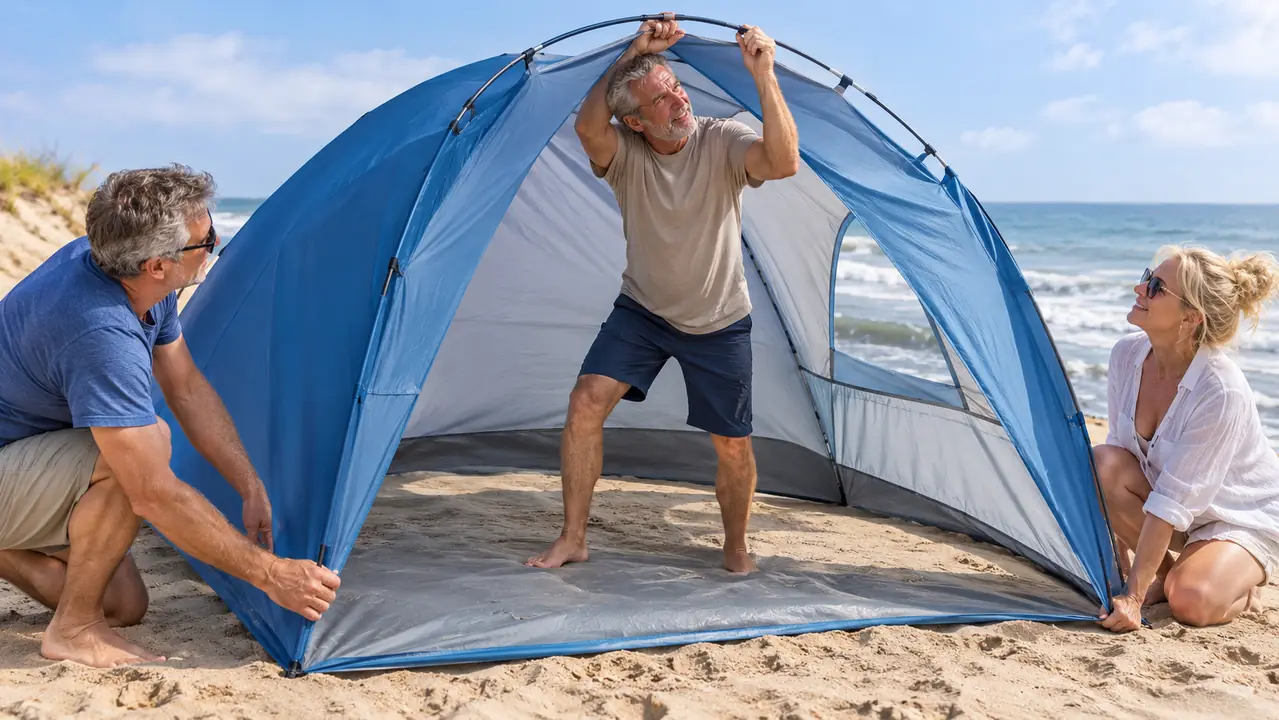
Here is where most people fight the wind. They grab the top of the tent and try to lift it into place, which turns the whole canopy into a sail. Do the opposite. Keep the Gorich low to the ground, hold the folded bundle by the center of the frame, and give it one firm shake to let the 8.0mm fiberglass frame pop the fabric open. The frame is what makes this tent work in wind. It is sturdy enough to stand on its own, and it does not bend and buckle the way the thin wire frames on cheaper tents do.
With the tent open but still low, I get down on my good knee and press the center of the top until the frame clicks into its full shape. Then I walk around the base, pushing each corner out to the floor corners of the blanket. Keep the whole thing low until every corner is where you want it. The wind can push against the top all it wants, but a tent that is still flat on the sand has nothing to catch.
If the wind is really gusting, I put a sandal or a small bag of gear on the upwind corner as soon as it opens. That one little weight buys me the two seconds I need to get the other corners sorted. It is not a permanent anchor, just a hand while I work.
Step 3: Stake the Upwind Corners First
The order you stake matters more than almost anything else. Most people start with the corner nearest them, which is usually downwind, and by the time they get around to the windy side the tent has already lifted. I always do the opposite. I stake the two upwind corners first, so the wind is pulling the tent against the stakes instead of lifting it off the sand.
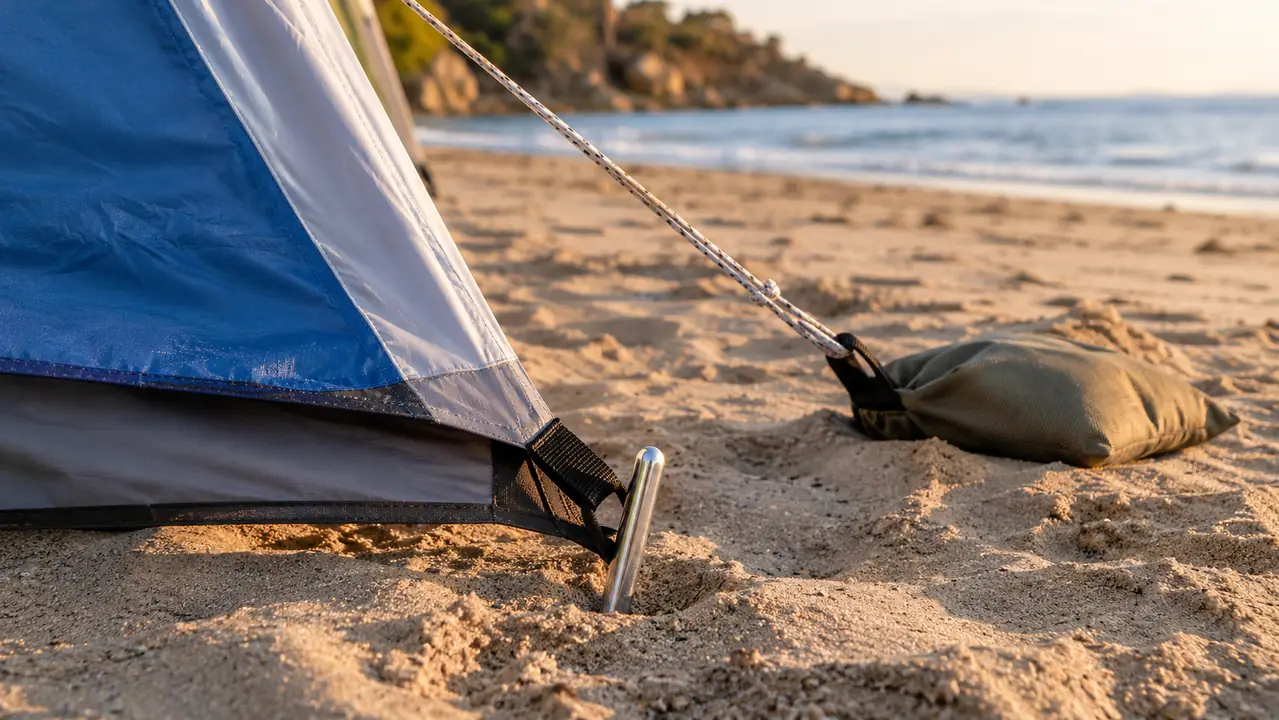
The Gorich comes with four stakes and four guylines, and I use every single one. I push each stake in at an angle, leaning away from the tent, not straight down. A straight stake pulls out of soft sand like a knife from butter. An angled stake holds like an anchor. I press it in with the heel of my hand, and if the sand is hard, I use the bottom of my water bottle as a little mallet. I learned the angle lesson on a gusty Tuesday in July when I was in a hurry and drove a stake straight down. The first real gust lifted that corner clean out of the sand and the tent flipped over the cooler. Lily and Mason thought it was the funniest thing they had seen all summer. I did not. Four seconds of wind undid what I had rushed, and it took me fifteen minutes to make it right. Now every stake gets the same lean, and I check each one before the kids come near.
After the upwind corners are set, I stake the downwind corners the same way. Then I walk around and give every stake a second push. Sand shifts, kids run past, and a stake that was fine at 9 a.m. can be loose at noon. That second push takes ten seconds and saves me from chasing the tent later.
Step 4: Run the Guylines Out at an Angle
The guylines are the part everybody skips, and they are the difference between a tent that naps and a tent that fights you all afternoon. The Gorich has four guylines, one at each corner, and I run every one of them out at about a 45 degree angle from the tent. Straight out is fine, but angled gives the line more leverage against a gust from the side. I used to leave the guylines in the bag because they looked like extra work and the tent seemed fine without them. Then a gust from the south picked up the whole tent with Ava's sippy cup inside it and set it down ten feet away, upside down, with the stakes still dangling from the corners. Nobody was hurt, but I have never skipped a guyline since. Now the lines go out before the kids even get their shoes off, and the tent stays where I put it.
I do not stake the guylines to the same little loops as the tent corners. I give them their own stakes, farther out, so the tent is being pulled in two directions at each corner. That triangulation is what keeps the whole shelter from rocking. If I am on sand that will not hold a stake, I fill a gallon bag with sand, tie the guyline around the top, and bury the bag a few inches down. It is the oldest trick in the book and it works.
Here is the part I learned the hard way: leave a little slack in the lines, then tighten them after the tent is fully pitched. If you pull a guyline too tight while the frame is still settling, you can tilt the whole tent. Once the frame is set and the corners are staked, I go back and pull each line snug, not guitar-string tight, just snug enough that the fabric stops flapping.
Step 5: Load the Inside Before You Trust It
A beach tent in wind is never truly done until it has weight inside. I put the cooler in the back corner, the beach bag in the front corner, and the kids' shoes in a pile in the middle. That is usually enough to keep the Gorich from budging even when a gust comes through the open front. The tent weighs about 3.5 pounds, and light things move, so the inside weight is part of the setup, not an afterthought. Last Labor Day the wind was strong enough that the flags were standing straight out, and the tent did not move once the cooler and bags were in. The frame gives a little when a gust hits, which is what it is supposed to do, and then it settles right back. A rigid frame would snap; this one just rides the breeze. That is the difference between anchoring a tent and just hoping.
Then I do the walk-around. I check every stake, every guyline, and the two corners where the fabric meets the sand. If anything is loose, I fix it before I call the kids over. With three grandkids under eight, I would rather spend two extra minutes checking than spend the afternoon chasing a tent down the beach.
Once everything is set, I put our towels down, hand out the sunscreen, and the tent does its job. The UPF 50+ fabric keeps the sun off, the 48 inch ceiling is tall enough for me to sit up straight under, and the open front lets me watch the water while Lily and Mason build sandcastles and Ava naps in the shade. That is the whole point of the system: ten minutes of setup, hours of sitting still.
What Else Helps
A few things I have learned that are not in any manual. First, I keep a small mesh bag with the stakes and guylines in the side pocket of my beach bag, so I am not digging through the sand looking for a stake. Second, I set up the Gorich before I get the kids out of the car. It takes ten minutes without three helpers, and about twenty with them. The tent is up, the blanket is down, and then the kids come out to a spot that is already ready.
Third, I point the open front of the tent toward the water, not toward the sun. The sun moves, but the breeze off the Gulf is usually steady, and a tent that faces the breeze stays cooler. Fourth, I take the tent down the same way I put it up: empty the inside, un-stake the downwind corners first, then the upwind corners, and let the frame collapse while the tent is still low. It folds down to a compact size that fits in the carrying bag, and it rides in the back of my silver CR-V all summer so I never forget it.
The order matters more than the strength. Stake the upwind corners first, run the guylines out at an angle, and a 3.5 pound tent will sit steady through a Gulf breeze.
Ten Minutes of Setup, Hours of Shade
If you are tired of fighting a floppy tent on a windy beach, the Gorich is worth a look. It is light enough for me to carry, simple enough for two people to set up, and honest about what it can and cannot do. Check today's price on Amazon.
Amazon Check Today's Price on Amazon →