
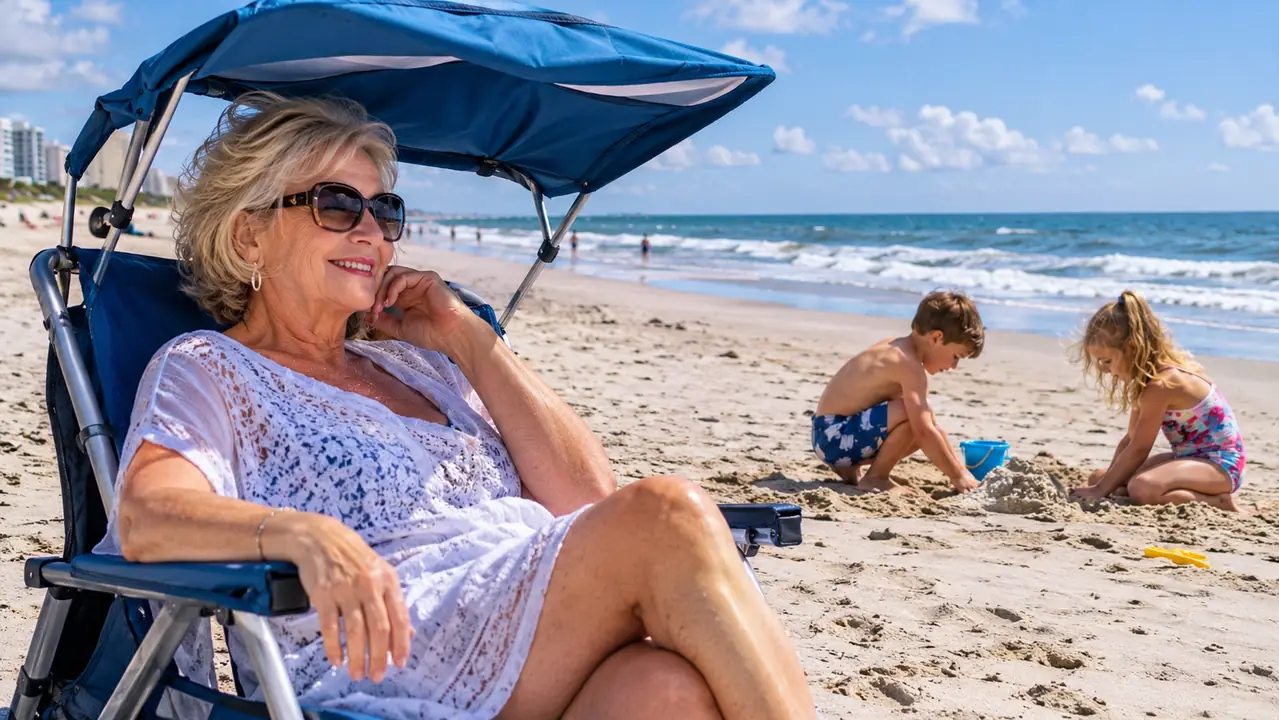
If you have ever spent a beach day perched on a towel with your knees up, or sunk so low in a sand chair that getting out felt like a team sport, you already know the problem. I am Marlene, a retired school nurse in Gulf Shores, and I take my three grandkids to the beach most summer weekends. Lily is eight, Mason is six, and Ava is four, and they can stay out there for hours. The question was never whether I could keep up with them. It was whether my back, my knees, and my patience could survive sitting in the wrong chair for that long.
The GCI Outdoor Sunshade Backpack Beach Chair is the chair that finally made the whole day work for me. It is a reclining folding canopy chair with a large back pocket, a drink holder, and carry straps, and it weighs 10.2 pounds. I have used it for a full season now, and this is exactly how I set it up, adjust it, and make it last from the parking lot to the last sandy ride home.
Stop fighting the sand and start enjoying the day
The GCI Outdoor Sunshade Backpack Beach Chair gives you a real backrest, a 4-position recline, and a UPF 50 canopy, all in a chair that carries like a backpack. Check today's price on Amazon and see why it has become the chair I reach for first.
Amazon Check Today's Price on Amazon →Step 1: Carry It Like a Backpack, Not Like a Burden
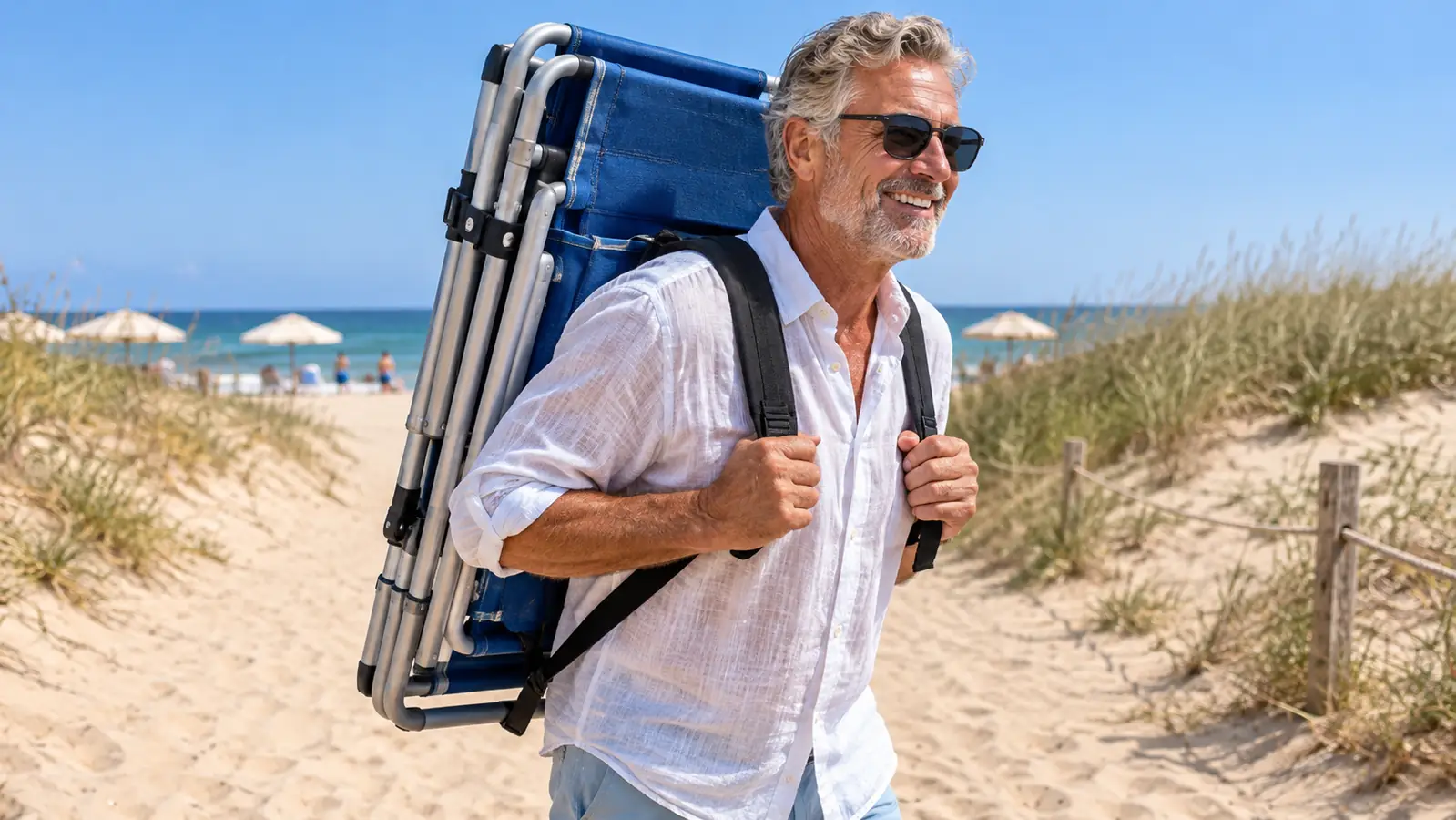
The walk from the parking lot at my usual beach access is long, and most of it is soft sand. With a cooler in one hand and a bag of towels in the other, the last thing I needed was a chair that had to be carried under my arm, with its handles digging into my palm the whole way. The GCI chair folds into a backpack shape with carry straps, so it rides on my back and leaves both hands free for the rest of the gear. With three kids, I need both hands for sunscreen, snacks, and the occasional rescue mission.
On a typical Saturday in June, we park the silver Honda CR-V at the far end of the lot because that is the only spot left by nine in the morning. From there it is a good two hundred yards of loose sand to the waterline, and the boardwalk ends halfway. I used to make that walk in two trips, chair under one arm, cooler dragging behind me, and I would arrive already done in. Now I slip the chair on my back first, hand Mason the sand toys, and let Ava carry her own water bottle. One trip, and we are set up before the kids lose interest in the walk.
One note from experience: the chair is 10.2 pounds, so it is not featherlight. But because the weight sits on your back instead of pulling on one arm, it feels easier than it sounds. My stiff left knee does not bother me nearly as much when I am carrying it this way. When we are ready to leave, it folds down to 4.3 inches deep, so it slips into the back of the CR-V between the stroller and the boogie boards without a fight.
Step 2: Set It Up on Firm Sand, Not a Sand Castle
When you unfold the GCI chair, you want the legs on the firmest sand you can find. The chair is rated for a hard floor surface, and while it works fine on packed sand near the waterline, it will sink if you set it up in dry, fluffy sand. I learned that the hard way on Memorial Day weekend. I set the chair up in a pretty spot near the dunes, not far from the towels, and within twenty minutes the back legs had sunk three inches. Every time I leaned back, the chair tilted a little more, and I spent the morning shifting my weight like I was on a boat. Now I take ten seconds to stomp the sand flat where the legs will sit, and I check the spot again after the kids have run past it a few times. Packed sand near the waterline is my first choice, but a stomped-down patch in the dry sand works fine too.
The frame is steel and aluminum with a polyester seat, and it opens to 26 inches deep, 24.2 inches wide, and 30.9 inches high. The seat height is 11 inches, which matters more than you might think. It is low enough to feel like a beach chair, but not so low that I have to fold myself in half to sit down. I have tried the low sand chairs that sit a few inches off the ground, and while they are easy to carry, I could not get out of one without help.
I also angle the chair slightly so the back is toward the prevailing breeze. That keeps the canopy from catching the wind like a sail, and it means the shade is where I want it before I even sit down. On a windy afternoon in July, that little angle kept the chair planted while the umbrella next to us took a tumble across the sand.
Step 3: Use the 4-Position Recline to Match the Moment
This is the feature that separates the GCI chair from every cheap beach chair I have owned. The 4-position reclining back lets me sit upright while I watch the kids in the water, lean back a little when I am reading, and go almost flat when the afternoon hits and I want to close my eyes. Most folding chairs only give you one position, so you either sit straight up or you do not sit at all.
Last Saturday was a good example. Lily was boogie boarding with Dave, so I sat upright in the first position to keep an eye on her. When she came in to build a sand castle with Mason and Ava, I moved back one notch and finished a chapter of my book. By two o'clock, with all three kids napping on towels in the shade, I went to the last position and dozed for twenty minutes. I did not have to get up once, and I did not have to ask anyone to hold my chair steady.
I adjust it by leaning forward slightly, moving the back to the next notch, and settling back in. It takes about two seconds, and I can do it without getting up. That matters when Ava is building a sand castle six feet away and I do not want to take my eyes off her. The chair supports up to 250 pounds, so it handles me and my beach bag with room to spare. The armrests are sturdy enough that I can push on them to stand up, which is something I test on every chair now because of my knee. That is the detail that matters most to me as I get older: I can get out of this chair without rocking it, without grabbing the canopy, and without asking a stranger for a hand.
Step 4: Position the UPF 50 Canopy So the Shade Finds You
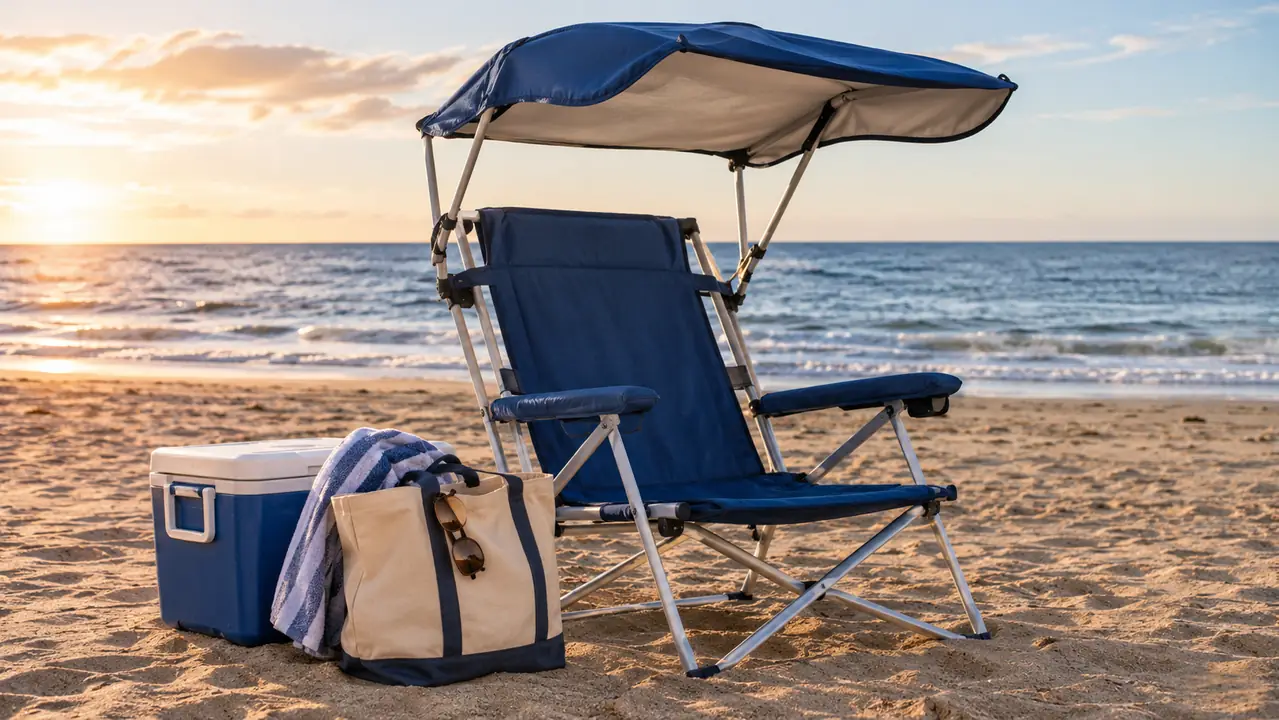
The adjustable UPF 50 canopy is the reason I can stay out for hours instead of retreating to the car by noon. The Alabama sun is no joke by ten in the morning, and shade is the difference between a full beach day and a short one. In the morning, I keep the canopy tilted forward to block the sun low on the horizon. By mid-afternoon, I tilt it the other way to shade my face and chest while the kids play in front of me.
On the Fourth of July, we got to the beach at eight in the morning to save a good spot, and the sun was still low over the water. I tilted the canopy forward and it shaded my face for the first two hours while the kids dug a hole big enough for Mason to sit in. By one o'clock, with the sun almost straight overhead, I flipped the tilt the other way and the shade landed on my shoulders and lap. The canopy is adjustable, so it did not take more than a few seconds each time.
The canopy is part of the chair, so it moves when I recline. That is the detail that makes it work. With a separate umbrella, you are constantly chasing the shade. With this chair, I adjust the canopy once and it stays where I put it. I still put sunscreen on before I sit down, because the canopy does not cover every inch of me. But it covers my face, my shoulders, and most of my lap, which is exactly what I need when I am parked for two hours while the kids dig. I keep the bottle in the back pocket and reapply when I stand up to check on Lily, and that routine has kept me from burning all summer.
Step 5: Use the Pockets and Drink Holder So Nothing Gets Lost in the Sand
The large back pocket is where I keep my sunglasses case, the sunscreen, and my phone. Lily knows the rule: if it is in Grandma's chair pocket, ask before you take it. That pocket has saved more sunglasses from the sand than I can count. Last month I watched a woman two chairs over spend ten minutes digging for her phone after it slid off her towel, and I reached into my pocket and handed her mine to call her husband. I also tuck a small bag of crackers in there for the walk back to the car.
The drink holder on the armrest keeps my water bottle upright and out of the sand. I learned that lesson the hard way with a cup that tipped over and sent sand into my drink within the first ten minutes. Now my water sits in the holder, and the kids know to hand me their cups one at a time instead of lining them up on the armrest. I use a bottle with a lid, never an open cup, and I tuck a napkin under it to catch the drips.
When the day is over, I wipe the chair clean with a damp cloth, let it dry in the sun for a few minutes, and fold it back into its backpack shape. The care instructions are simple: wipe clean. That is the whole maintenance routine, and it takes less time than folding the towels. The salt air here is hard on everything metal, so I give the frame a quick rinse with fresh water before I wipe it down. I have had chairs that needed a screwdriver and a prayer after one season in the salt air; this one just gets a rinse and a wipe and it is ready for the next trip.
What Else Helps
A good chair is the center of a comfortable beach day, but it is not the whole story. I bring a small mat to put under the chair so the legs do not sink into soft sand. I keep a thin towel over the seat when the sun has heated the polyester, and I always have a second towel to cover my legs when the breeze picks up. A wide-brimmed hat still earns its place in my bag even with the canopy, and the kids know that the chair is for sitting, not for jumping on. I also pack the chair last in the car so it comes out first, and I keep a small bottle of water in the drink holder from the moment we arrive. I keep a pair of flip-flops in the back pocket so I am not walking barefoot to the water's edge. Little routines like that mean I am not hunting for things while three kids are already running toward the water. With those small habits, the GCI Outdoor chair has turned my beach days from a test of endurance into the best part of the week.
The GCI chair weighs 10.2 pounds, opens to a 26 by 24.2 by 30.9 inch frame, and the 4-position recline means I can watch the kids, read, or nap without ever leaving my spot.
Give your beach day a real seat
The GCI Outdoor Sunshade Backpack Beach Chair is the chair I reach for every single trip. It carries like a backpack, shades like an umbrella, and reclines in four positions. Check today's price on Amazon and see if it is the missing piece in your beach bag.
Amazon Check Today's Price on Amazon →