
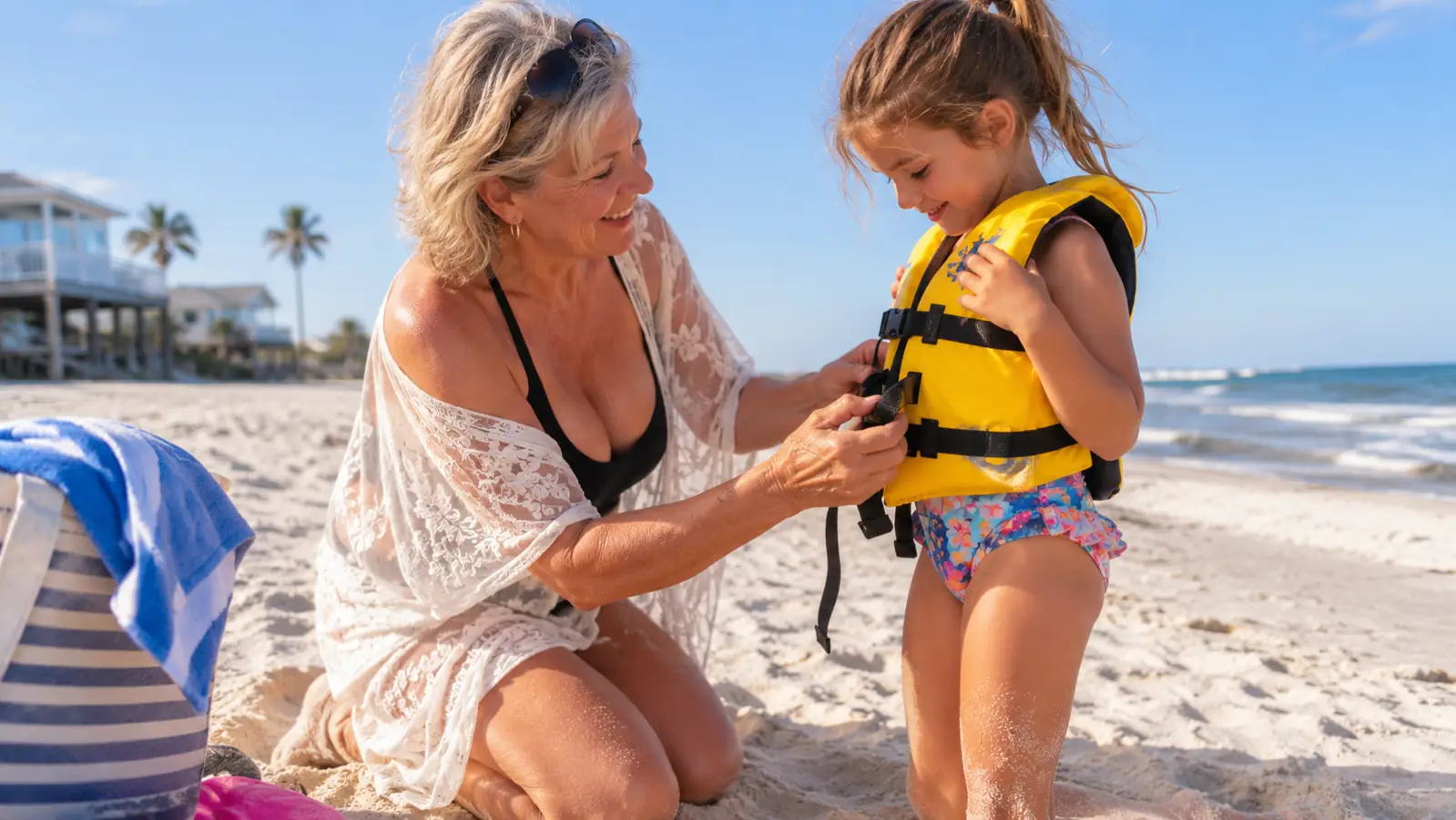
I was a school nurse for thirty-one years, and I have been a grandmother for nine, and I will tell you the honest truth: putting a life jacket on a wiggly four-year-old is about ten percent about the jacket and ninety percent about the fit. Ava can make a properly buckled vest look like a costume she is about to escape from. Mason can have his straps twisted before we reach the water. And Lily, at eight and about 52 pounds, has outgrown the Paddle Pals entirely, which is its own lesson about checking the size every single season. I am Marlene Hollis, I live about fifteen minutes from the beach in Gulf Shores, Alabama, and I have been hauling grandchildren, beach chairs, and a very full cooler across the sand most summer weekends for the past several years.
The Body Glove Paddle Pals is the vest my two youngest grandkids have worn for three summers now, and it is the one I reach for when I take all three of them to the beach. Mason is six and about 44 pounds. Ava is four and about 36 pounds. Both of them are inside the 33 to 55 pound range this vest is made for, and both of them wear it well. But no vest does its job if it is loose, twisted, or riding up around the ears. So here is the exact routine I use on the sand, in the parking lot, before any of them gets within ten feet of the water. It takes about five minutes once you know what you are looking for, and it has kept three grandkids safe through a lot of beach days.
Start With a Vest That Fits Before You Worry About the Straps
The Body Glove Paddle Pals is sized for kids 33 to 55 pounds, which is exactly where Mason and Ava land. Check today's price on Amazon and have it in hand before your next beach day.
Amazon Check Today's Price on Amazon →Step 1: Check the Size Before You Buckle Anything
The Paddle Pals is a one-size vest for kids 33 to 55 pounds. That is a wide range, and it means the fit check matters more, not less. Mason is six and about 44 pounds. Ava is four and about 36 pounds. Both are inside that window, but the vest sits completely differently on each of them. If I put Ava's vest on Mason without adjusting anything, the shoulder harness would sit too low and the whole thing would ride up the moment he hit the water. If I put Mason's vest on Ava, the straps would be too loose and the vest would not do its job. Size is not about age. It is about weight, and it is about how the vest actually sits on the child's body.
So the first thing I do is hold the vest up against their back before I buckle a single strap. The bottom edge should sit at their waist, not at their ribs and not at their hips. If the vest is so long that it covers their bottom, it is too big. If it looks like a bib that barely reaches their chest, it is too small. I also check the weight label inside the vest every single trip, because kids grow fast and a vest that fit in May can be too small by July. Lily is the perfect example. She wore the Paddle Pals at six, and by the time she was eight and about 52 pounds, she had outgrown it. She now wears a youth vest, and she is a confident enough swimmer that she does not need the Paddle Pals anymore. But the point stands: check the size every time.
One more thing I check at this stage: the condition of the vest. The Body Glove Paddle Pals is made of durable polyester, and ours has held up to three summers of sand, sunscreen, and saltwater. But I still run my fingers along the straps and buckles before I put it on a child. A frayed strap or a cracked buckle is a reason to retire the vest, not to test it. The USCG approval on this vest only means something if the vest is in good condition and fitted properly. A damaged vest is not a safe vest, no matter what the label says.
Step 2: Buckle Every Strap, Then Tighten From the Bottom Up
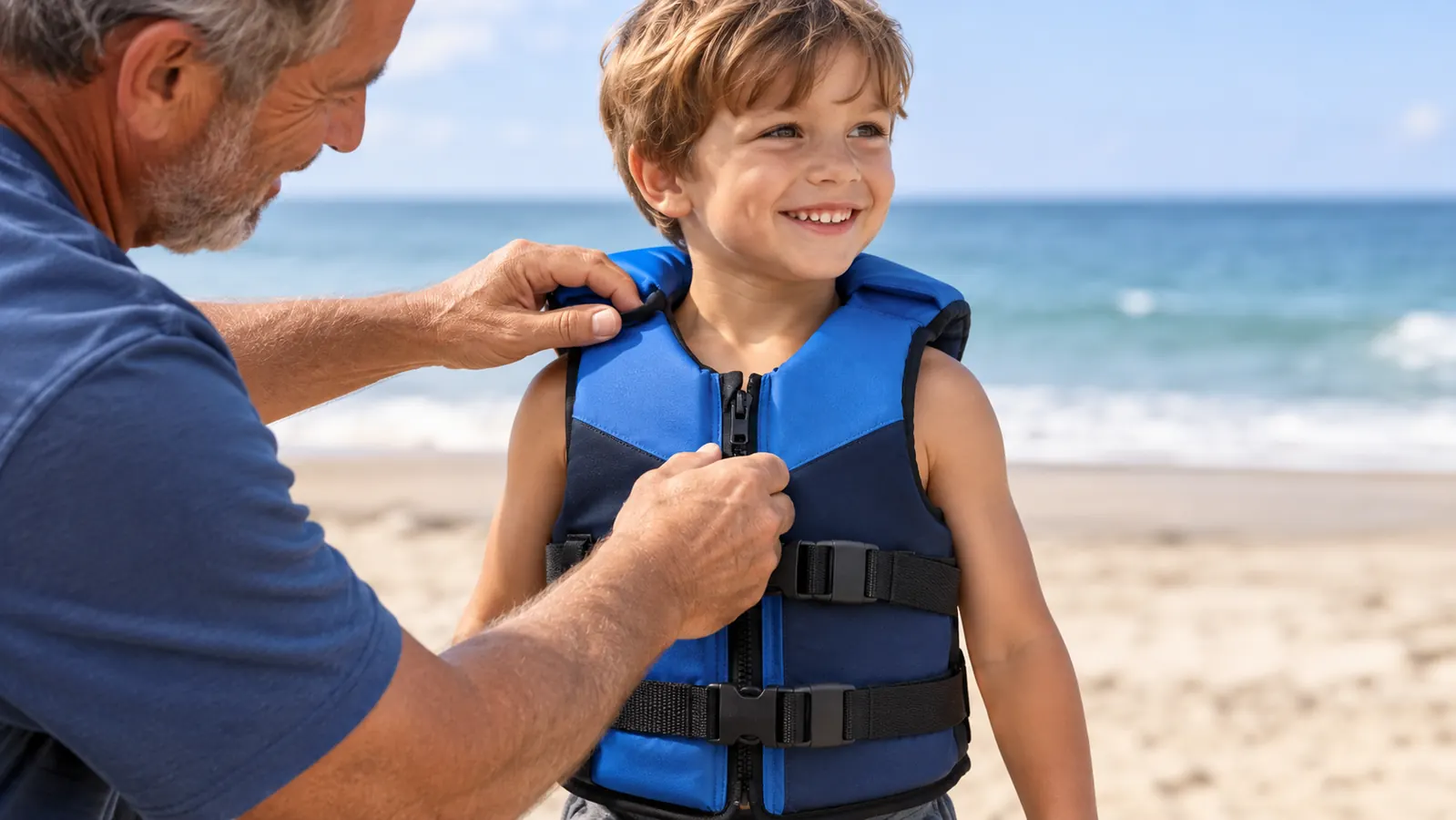
The Paddle Pals has a patented shoulder harness that does two jobs: it helps keep the vest from riding up, and it gives me something solid to grab when I am helping a child out of the water. But the harness only works if the straps are actually buckled and snug. I have seen parents on the beach buckle the chest strap and leave the lower straps dangling, or vice versa. Every strap on the vest has a job, and every strap needs to be buckled before the vest is doing what it is supposed to do.
My order is always bottom to top. I buckle the lowest strap first, then the middle, then the chest, and I adjust the shoulder harness last. Going bottom-up keeps the vest from creeping up while I am working. If I tighten the top first, the bottom rides up and I have to start over. With a wiggly six-year-old, starting over is the last thing I want. Mason in particular can unbuckle a strap with his toes, or so it seems. So I buckle, check, and then buckle again.
When I tighten, I pull until the vest is snug against their body but not squeezing. The test I use is the two-finger test. I should be able to get two fingers flat under the strap, but not much more. If I can slide my whole hand under, it is too loose. If I cannot get two fingers in at all, it is too tight and they will be miserable before we even reach the water. A miserable child is a child who wants to take the vest off, and a child who wants the vest off is a child I have to watch even more closely. Snug, not squeezing, is the goal.
Step 3: Do the Lift Test on the Shoulders
Here is the test I do on every child, every single time, and it is the one I wish every parent knew. I take the top of the shoulder harness in both hands and pull straight up. If the vest rides up over their chin or their ears, it is too loose, full stop. A properly fitted vest should stay put when you lift it. The patented shoulder harness on the Body Glove Paddle Pals is exactly what makes this test pass or fail. When the harness is adjusted right, the vest stays down on the torso where it belongs.
The reason this matters is what happens in the water. A loose vest rides up toward the face, and a scared child will push it down, which makes everything worse. The whole point of the shoulder harness is to keep the vest down on the torso where it belongs. If the lift test fails, I unbuckle, tighten the shoulder straps, and start again. It takes ninety seconds and it is the difference between a vest that works and a vest that is just along for the ride. I do this test on Mason and Ava every single time, even if we were at the beach yesterday. Kids grow, straps loosen, and vests shift. The test takes five seconds, so there is no excuse to skip it.
I also do the lift test on Lily's youth vest, even though she is older and a stronger swimmer. The rules do not change just because a child is more confident in the water. Every child wears a properly fitted, properly buckled vest when they are in the gulf. That is not negotiable in our family, and it is the reason I have never had a scary moment with any of the three of them in the water.

Step 4: Watch How It Sits When They Move
A vest can pass every static check and still fail the moment a child starts moving. So after the lift test, I have Mason and Ava walk a few steps, reach up, bend over, and pretend to paddle. I am watching the vest the whole time. Does it stay in place? Does the shoulder harness stay put? Does the bottom edge creep up toward their chin? If I see any of that, we go back to Step 2 and tighten. The multi-panel design of the Paddle Pals helps it move with the child instead of against them, but only if the straps are doing their job.
This is also where I check the lower straps, and I watch for any sign of the vest riding up. The Paddle Pals uses its patented shoulder harness and multi-panel design to keep the vest down, and on our vests the fit stays put once it is snug. But I still watch. A child who is wearing a vest that is too loose will tell you with their body before they tell you with words. They will hike it up, tug at it, or try to take it off entirely. That is not a behavioral problem. That is a fit problem, and the fix is to tighten the straps, not to scold the child.
I also pay attention to how the vest feels when they are walking across the sand. The walk from the parking lot to the water at our beach access is a long one over soft sand, and I have learned to let the kids walk in their vests so I can see how the vests behave in motion. If a vest is going to ride up, it will do it on that walk, before we even get to the water. That gives me a chance to fix it while we are still on dry sand, where it is easy to unbuckle and adjust.
Step 5: Recheck After They Get Wet and After Every Swim
Here is the step almost nobody does, and it is the one that matters most. The moment a child hits the water, the vest shifts. Straps loosen. The whole thing rides up half an inch. So my rule is simple: the first time they come out of the water, I recheck the fit. I pull the shoulder harness, I re-tighten the straps, and I do the two-finger test again. It takes sixty seconds and it prevents the exact situation where a vest stops working halfway through the afternoon.
I also recheck every time we take a break. Sand gets in the buckles. Sunscreen makes the straps slippery. A vest that was perfect at nine in the morning can be loose by noon. Mason in particular manages to loosen his straps just by being Mason. So the recheck is not a one-time thing. It is part of the rhythm of the beach day, like reapplying sunscreen and refilling the water bottles. I keep a small towel in the beach bag just for drying off the buckles before I re-tighten them.
And at the end of the day, I rinse the vests in fresh water and hang them to dry. The Paddle Pals is made of durable polyester, so it handles the saltwater fine, but rinsing keeps the sand out of the buckles and keeps the straps from getting stiff. A vest that is clean and dry is a vest that is ready for the next trip. I hang ours on the porch railing overnight, and in the morning they are ready to go back into the beach bag.
What Else Helps
A properly fitted vest is the foundation, but it is not the whole plan. I keep a few other habits that make the beach day safer and easier. I put the vests on in the parking lot, not at the water's edge, so I have a flat, dry surface and a child who is not already distracted by the waves. I bring a spare set of straps and buckles, though the Paddle Pals has held up so well I have not needed them yet. And I never, ever let a child wear a vest that is not buckled, even for one minute, even on the sand. It takes one second for a toddler to head for the water.
I also check the vests at the start of every season, not just every trip. I look at the straps, the buckles, the seams, and the fabric. The Body Glove Paddle Pals is made of durable polyester, and ours has lasted three summers, but I do not assume it will last a fourth. When a vest shows real wear, I replace it. A life jacket is not the place to squeeze out one more season. The same goes for the youth vest Lily wears now. I check it the same way, even though she is a stronger swimmer.
One more habit that has made a real difference for me: I park the silver Honda CR-V in the lot and use a small wagon to haul the chairs, the cooler, and the bags across the soft sand. My left knee is stiff, so I cannot carry everything the way I used to. The wagon means I have both hands free to hold Ava's hand on the walk to the water, and that is worth more than any piece of gear in the bag. The vests go in the wagon on top, so they are the first thing I grab when we set up camp.
The lift test is the one I wish every parent knew: pull the shoulder harness straight up, and if it rides over the chin, it is too loose. That test takes five seconds and it has never once lied to me.
A Snug Vest Is a Safe Vest
The Body Glove Paddle Pals is the vest I have trusted for three summers of beach days with my grandkids. Check today's price on Amazon and do the five-step fit check before your next trip.
Amazon Check Today's Price on Amazon →